
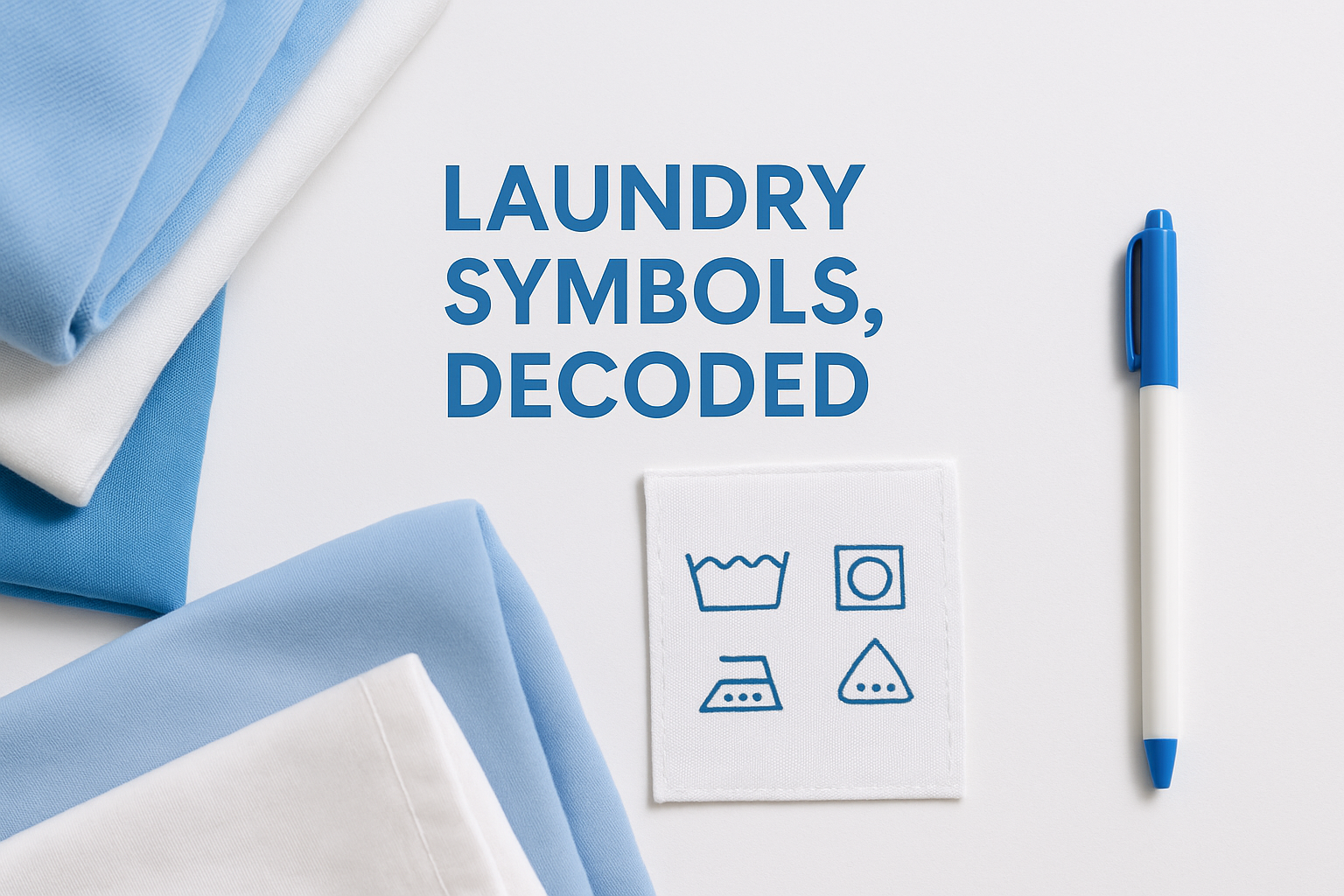
Why Symbols Matter (and How They Save You Money)
If you’ve ever ruined a favorite shirt because you guessed at a care tag, you’re not alone. Laundry symbols were created to give quick instructions regardless of language, but they can feel cryptic—especially when you’re rushing. The fix is simple: learn the handful of core icons and how modifiers (dots, bars, and X’s) change their meaning. Understanding them prevents shrinkage, fading, and fiber damage, which means fewer replacements and longer-lasting linens at home and at work.
At Washerman’s Laundromat in Elizabeth, NJ, our team interprets care tags every day for Wash & Fold and commercial orders. Below is the exact way our pros read those icons—plus quick decisions you can apply at home.
1) The Five Core Categories of Laundry Symbols
Nearly every care tag uses the same five shapes:
- Tub = Washing
- Triangle = Bleaching
- Square (with extras) = Drying
- Iron = Ironing
- Circle = Professional cleaning (dry clean/wet clean)
Memorize those shapes once, and the rest is just details.
2) Washing Symbols (the Tub)
- Empty tub = machine wash permitted.
- Tub with number (30/40/60) = max °C (think: 30 = cold, 40 = warm, 60 = hot).
- Tub with dots = temp without numbers:
- 1 dot = cold
- 2 dots = warm
- 3 dots = hot
- Tub + hand = hand wash only.
- Tub with line under = gentle cycle.
- Two lines under = very gentle/delicate (e.g., silk, cashmere).
- Tub with X = do not wash (usually dry clean).
Washerman’s tip: If you’re unsure about a new item’s dye stability (dark denim, saturated reds), wash it inside out on cold with similar colors for the first few cycles.
3) Bleach Symbols (the Triangle)
- Empty triangle = bleach allowed.
- Triangle with diagonal lines = oxygen/non-chlorine bleach only.
- Triangle with X = no bleach.
When in doubt: Choose oxygen bleach for whites and color-safe formulations for brights; avoid chlorine on elastics and printed graphics.
4) Drying Symbols (the Square)
Drying has the most variations because heat + motion = risk.
Tumble Dry (circle inside a square):
- Empty: tumble dry allowed.
- Dots inside indicate heat: 1 dot = low, 2 dots = medium, 3 dots = high.
- Line under = gentle tumble.
- X = do not tumble dry.
Natural (line) drying (plain square with lines):
- Horizontal line = lay flat to dry (prevents stretching).
- Vertical line = line dry.
- Three vertical lines = drip dry (don’t wring).
- Curved line at top = dry in shade (protects dyes).
Washerman’s tip: Most shrinkage happens in the dryer, not the washer. When a tag allows tumble drying but you love the garment, choose low heat and remove it slightly damp; finish on a rack.
5) Ironing Symbols (the Iron)
- Empty iron = ironing allowed.
- Dots = temp: 1 = low/synthetics, 2 = medium/silk/wool, 3 = high/cotton/linen.
- X = do not iron.
- Iron with steam lines crossed out = iron without steam.
Pro move: A garment steamer is kinder to fibers than a hot, heavy iron. For prints/transfers, iron inside out with a pressing cloth.
6) Professional Cleaning Symbols (the Circle)
- Empty circle = dry clean. Letters inside (P/F) guide solvents to the cleaner.
- Circle with W = professional wet cleaning recommended.
- Circle with X = do not dry clean.
For anything labeled “do not wash,” trust the tag—especially suits, structured dresses, and items with interlinings.
7) Putting It Together: Real-World Scenarios
Scenario A: Workout leggings
Symbols: tub (30°C •), triangle with X, square with 1 dot, iron with X.
Translation: cold wash, no bleach, low tumble or air-dry, do not iron.
Why: Fabric softener and high heat degrade stretch fibers—skip both.
Scenario B: White cotton towels
Symbols: tub (60°C •••), triangle (oxygen OK), square (2 dots), and iron (3 dots).
Translation: warm/hot wash, color-safe bleach when needed, medium dry, high iron if desired.
Why: Heat sanitizes and preserves loft when not overdried.
Scenario C: Wool sweater
Symbols: tub with hand and two lines, square with horizontal line, iron (1 dot), and triangle X.
Translation: hand wash (very gentle), lay flat to dry, cool iron, no bleach.
Why: Wool felts with agitation and heat; flat drying preserves shape.
Scenario D: Restaurant linens (poly/cotton blend)
Symbols: tub (40–60°C), triangle with diagonal lines, tumble dry (2 dots), and iron (2–3 dots).
Commercial tip: Consistent temps and proper dosing extend textile life and keep whites bright without harsh chlorine.
8) Common Myths—Busted
- Myth: “Hot water cleans best.”
Reality: Modern detergents are engineered for cold and warm. Save hot for whites/heavily soiled items only. - Myth: “More detergent = cleaner.”
Reality: Overusing detergent leaves residue that traps odor and dulls colors. - Myth: “Fabric softener is always good.”
Reality: It can coat fibers (especially towels/activewear). Use wool dryer balls or occasional vinegar rinses instead.
9) Quick-Reference Symbol Key (save this!)
- Tub: wash (dots = temp, lines = gentle).
- Triangle: bleach (diagonals = oxygen only).
- Square + circle: tumble dry (dots = heat).
- Square + lines: natural dry (flat/line/drip/shade).
- Iron: iron temp (dots).
- Circle: dry clean/wet clean.
10) Washerman’s Pro Workflow (What We Do for You)
For Wash & Fold and commercial orders, we:
- Read every tag and sort by color, fabric, and soil level.
- Match cycle + temp to the most delicate item in each batch.
- Use eco-safe, low-residue detergents.
- Dry on low/medium, remove promptly, and fold immediately.
- Package cleanly so your items go straight to the shelf or hanger.
Final Thoughts
Care symbols aren’t a puzzle—they’re your garment’s own best advice. When you follow them, clothes last longer, whites stay brighter, and delicate fabrics keep their shape. If you’d rather never think about it again, Washerman’s will read the tags for you and return everything fresh, folded, and ready to use.
💙 Laundry science, simplified.
Schedule a Wash & Fold pickup at washermans.com or call 844-HEY-COBY. Serving Union, Essex, and Bergen Counties.